Meet Iryna in Ukraine
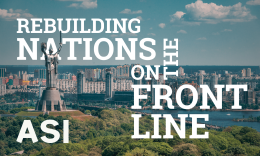
Our “ASI Game Changers” series introduces the people who make our work possible, and allows us to learn about what drives them in their quest to create lasting impact in some of the world’s most challenging, complex environments. In this edition, we speak to our colleague Iryna Dobrohorska, Senior Manager, Governance & Stability in London and Kyiv.

- Name: Iryna Dobrohorska
- Role: Senior Manager, Governance & Stability
- Locations: Kyiv, Ukraine & London, UK
What’s your big “why”? What’s the positive change/impact you and others in your field are trying to achieve and what are some of the challenges you face whilst doing so?
Looking back, the turning point for me was the Euromaidan revolution in 2014. I was a student, and Ukraine was at a crossroads. The country chose a European path, government changed, and there was a big push for young people to join the reform process. When I graduated, many of my friends went to work in parliament or in executive bodies. I was motivated to join that broader generational shift.
After a master’s in European studies, my first job was in the development sector. I could see that what I was supporting actually mattered – it wasn’t just paperwork, it was shaping the future of my country. Since 2022, when Russia invaded, it’s also been a personal question for me as a citizen: if I’m not serving in the armed forces, what can I do for Ukraine? Professionally, I found the answer – I was already quite engaged – and that kept me motivated to stay in this sector.
If you could write your own job title that best describes what you do here, what would it be?
This is always the hardest question because not many people know what international development actually is. For those in the know, I say I’m building ASI’s Ukraine presence: helping the company expand its work and bring the best of UK and international expertise into Ukraine. That also goes beyond the UK profile — there are EU integration angles where our track record is relevant.
For those who don’t know the sector, I keep it simple: I support Ukraine with reform processes and policy so the country can improve its governance and systems. I think that’s how my parents see my work (though I’m not entirely sure!).
What do you like about working in a global development company?
The variety. One week I’m in a bid team with people from four continents, the next I’m working alongside specialists who’ve tackled problems in completely different ways.
I bring insight into how things work in Ukraine — or how they don’t — and in return I’m learning what’s worked elsewhere. Everyone brings their own lens, and that’s why the quality is so high and our final products so strong. It motivates me and I feel like I’m growing every day.
What’s the most exciting thing happening in your project/at work right now?
We’ve recently expanded our work in Ukraine, which is always exciting. But the bid that’s really caught me is civilian security sector reform. I’ve been looking at how the UK’s expertise in this area used to be embedded in Ukraine, how that shifted after Brexit, and how it can be applied now — during a war, with all the challenges that brings: human rights violations, transitional justice issues, civilian agencies taking on some military functions (for example, police in combat), how that works in other contexts, and what model might be most suitable for Ukraine.
I’m also working on public investment management reform under the Green Cities Infrastructure and Energy programme. When I started, I did not know much about the subject matter — now I’ve learned a lot. That’s the beauty of this job: you’re constantly pushed out of your bubble.
What movements or discussions inspire you generally right now?
Gender equality and women’s empowerment is something I reflect on a lot – not just in the context of work or the armed forces, but in sport and other spaces too. I think about what my space is in the broader picture.
With everything going on in Ukraine and elsewhere, I also want to explore transitional justice and human rights more. Because I work so much on Ukraine, I don’t always have the best awareness of other regional contexts, and there are universal values that should be respected across them. Human rights isn’t black and white; it provokes your thinking and pushes you to look at issues more broadly.
What volunteering or passion projects do you do outside of work?
I don’t currently volunteer with an initiative, but like many Ukrainians I help with fundraising for friends serving in the army. I also love gastronomy – I like to bake. A year and a half ago, I ran a baking stall at a Christmas market in London to raise funds for Ukraine.
I played the Ukrainian traditional string instrument, the bandura, in a large ensemble for over a decade, touring with Ukrainian folk music and fundraising for orphanages.
When the war started, I also helped foreign media explain what was happening in Ukraine and cover stories accurately. It began by chance – a French-speaking fixer gig if you like – and grew into freelance writing and media production, including frontline reporting.
What’s a quality a game changer should have and what’s your ambition to be one?
You have to be bold — in decisions, in ways of thinking, and in doing things you didn’t necessarily think you were capable of. That can be on a project or outside work, and it can still have an impact on how you think and how you work. My aim is to keep that boldness: to stretch what I think I can do and apply it back into the work for Ukraine.
And finally, what’s something you want people to know about Ukraine?
I don’t want Ukraine to be known only as “the country at war.” Yes, we are resilient – and I know that word gets overused – but it’s more than that. We’re choosing our own path, building a democratic country, and living our lives with purpose despite everything.
We have a rich culture, a melodic language, and yes, we’ve won Eurovision three times (laughs). We’re good at football and boxing too. There’s so much more to us than just our resistance to our neighbour in the north.